Many healthy dogs do well with a bath every 4 to 12 weeks, according to Virginia Tech's veterinary teaching hospital, though frequency depends on coat type and lifestyle.1 Bathe sooner if the coat gets very dirty or smells bad,2 but as a rule, not more often than weekly unless your vet says so.3
Why is there no single answer?
There is no single answer because dogs differ: how often you bathe depends on breed, coat length, activity level and any health conditions, according to Washington State University's veterinary teaching hospital.4 A short-coated dog that naps on the couch and a long-haired dog that swims in the lake are on different schedules.
Veterinary sources give a fairly wide spread for healthy dogs. The Merck Veterinary Manual suggests about once a month, depending on the season.2 Texas A&M's veterinary college says dogs without skin problems benefit from a bath a couple of times a year, or when they get dirty.5
| Situation | Guidance |
|---|---|
| Many healthy dogs | Every 4 to 12 weeks, depending on coat type and lifestyle1 |
| General routine | About monthly, depending on the season, or when very dirty or smelly2 |
| Healthy skin, no skin problems | A couple of times a year, or when dirty5 |
| Upper limit | No more than weekly unless your vet advises otherwise3 |
| Dog with a skin problem | Discuss bathing with your vet5 |
Can you bathe a dog too often?
Yes. Washington State University's veterinary hospital warns that bathing too often "can strip its coat of protective oils."4 That is why the usual ceiling is weekly, unless your vet tells you otherwise.3
The product matters too. Harsh bathing products can damage the skin barrier, leaving skin dry and irritated.1
What are the signs it is bath time?
It is bath time when your dog's coat gets very dirty or smells bad.2 Short of that, there is no date to hit: bathe your dog whenever it needs a bath.3
In other words, let the coat set the calendar.
Should you use dog shampoo or human shampoo?
Use a shampoo made for pets, not one made for humans.1 The reason is pH: human shampoos and conditioners have pH levels that can harm your dog's skin and cause irritation.3
For a dog with healthy skin, any shampoo formulated for dogs should work fine.3 Checking who a product is formulated for is a habit worth keeping for what your dog eats, too. Our guide to how to read a dog supplement label shows how.
How do you bathe a dog step by step?
Brush first, wash gently, rinse more than you think you need to, then dry completely. Here is the full routine:1
- Brush thoroughly before the coat gets wet, to remove loose hair and mats that trap water and shampoo against the skin.
- Wet the coat with lukewarm water.
- Apply shampoo gently with your fingertips in circular motions, working from neck to tail.
- Keep shampoo away from the eyes, ears and nose.
- Rinse thoroughly. If you feel slickness or see foam, keep rinsing.
- Pay special attention to the armpits, groin, under the tail, between the toes and behind the ears.
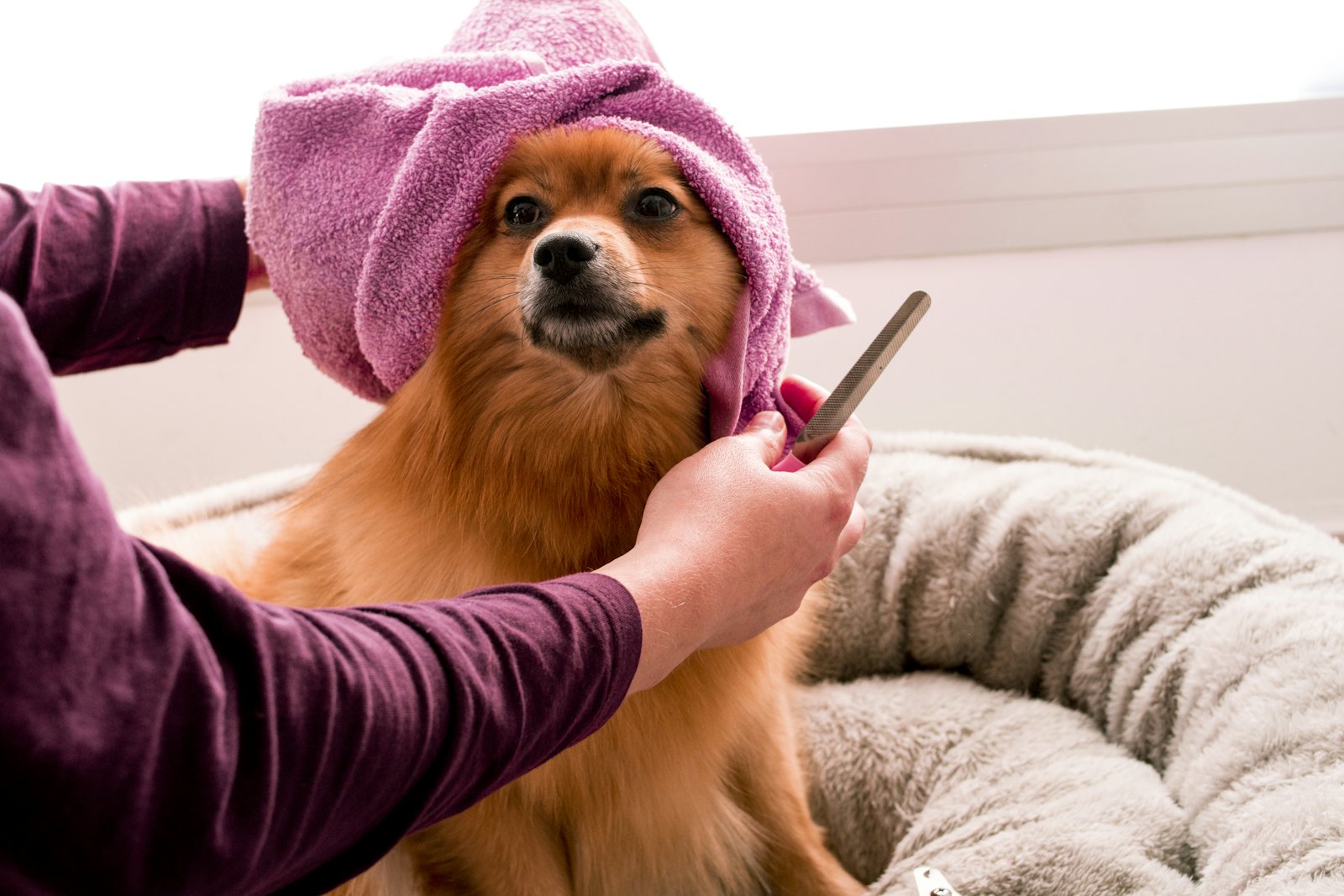
- Press towels against the coat rather than rubbing.
- If you use a blow dryer, keep it on cool or low and keep it moving, since heat held in one spot can burn skin.
- Make sure your dog dries completely, especially in skin folds and between the toes.
If your dog has longer fur, comb it out before the bath, because wet fur mats more than dry fur and can be difficult to untangle.4
How should you brush between baths?
Brush regularly to remove loose hair and prevent mats, which is especially important for dogs with thick or long fur.2 Mats are more than a cosmetic issue, since matted hair can irritate the skin.2
Long coats need the most help here, since animals with long hair coats are prone to matting.5 Brushing sticks best at the same moment each day, the cue-based habit our guide to a daily supplement routine for dogs walks through.
What should you check before every bath?
Check the coat, the calendar and the skin before the water goes on. This quick check pulls the guidance above into one place.
| If this is true today | Do this |
|---|---|
| The coat is very dirty or smells bad | Bathe, using a shampoo made for pets2 |
| You already bathed your dog this week | Wait, unless your vet has advised more frequent baths3 |
| A longer coat has tangles or mats | Comb or brush it out before the coat gets wet, since wet fur mats more than dry fur4 |
| The skin is inflamed, has open sores, or your dog seems uncomfortable when touched | Hold the bath and call your vet1 |
When should you talk to your vet instead?
When the skin looks or feels wrong, your vet comes before the shampoo. Skip the bath and call your vet if your dog has inflamed skin, open sores, or seems uncomfortable when touched.1 Contact your veterinarian, too, if redness, bumps, excessive scratching or unusual odor show up after bathing.1
Losing hair, seeming excessively itchy and red spots on the skin are among the signs a dog might be sick, so see your vet if a sign lasts more than 1 or 2 days.2 If your dog has a skin problem, discuss bathing recommendations with your veterinarian. More severe or persistent skin conditions may benefit from examination by a boarded specialist in veterinary dermatology.5
For more practical care guides, browse more Learn guides.
pawIQ makes daily soft chews for dogs and is launching soon. Get launch updates.
Frequently asked questions.
Can I wash my dog with dish soap?
It is better not to. Dish soap may lift dirt and odor, but products formulated for veterinary use are the better choice.4
How do I get a nervous dog used to baths?
Go slowly and make it rewarding. Try positive reinforcement such as a treat, avoid going overboard the first couple of times, and start with your dog only toe deep in the tub.3
Can I cut mats out with scissors?
You should not. The Merck Veterinary Manual warns that "it's easy to accidentally cut the skin," and suggests electric clippers made for clipping pets' hair instead.2
Should I clean my dog's ears with cotton swabs at bath time?
No, cotton swabs should never be used to clean a dog's ears, because this can lead to potential damage of the ear canal. Dogs that swim a lot are more prone to ear problems and should be monitored more closely.5 Your vet can suggest an ear-care routine.
Sources.
- Virginia-Maryland College of Veterinary Medicine, Veterinary Teaching Hospital. Safe bathing practices: protecting your pet's skin. Virginia Tech, 2026.
- Antinoff N. Routine Health Care of Dogs. Merck Veterinary Manual, Dog Owners, reviewed 2025.
- Texas A&M College of Veterinary Medicine & Biomedical Sciences. Basic grooming. Pet Talk, 2014.
- Washington State University College of Veterinary Medicine, Veterinary Teaching Hospital. Bathing your dog. WSU, 2021.
- Texas A&M College of Veterinary Medicine & Biomedical Sciences. Proper pet hygiene. Pet Talk, 2017.